Camata Presents at Getty Colloquium
Prof. Guido Camata, Partner and Technical Director at ASDEA S.rl., was asked to participate in a colloquium for the Seismic Retrofitting Project. The Seismic Retrofitting Project is an Earthen Architecture Initiative project, supported by the Getty Conservation Institute Council in conjunction with the Peruvian Ministry of Culture, to develop peer-reviewed guidelines for potential inclusion in the Peruvian Building code regarding retrofitting designs and techniques.
A panel composed of notable experts from around the world was convened for the colloquium to discuss the topic and generate a discussion on experiences and best practices. Camata was one of three Italians asked to speak in the colloquium, which also featured experts from North and South America, Asia, and Europe.
In his lecture, Camata addressed the primary criteria for seismic vulnerability evaluation and intervention efficacy, the guidelines produced by MIBAC (Italian Ministry of Culture), and included several illustrative fieldwork experiences, including projects developed by ASDEA S.r.l.
Related Articles

Civic Tower of Ravenna – Blending Ancient Techniques with Modern Technology
Discover how ASDEA’s MonStr Hardware protects the Civic Tower of Ravenna through smart structural health monitoring. Learn how modern technology and ancient craftsmanship combine for proactive heritage preservation.

The Importance of Seismic Design in Structural Engineering- Ensuring Safety in High-Risk Regions
Seismic design is essential for earthquake resilience. This blog explores key structural engineering principles, advanced techniques like capacity design, and the role of advanced simulation tools such as Asdea STKO for OpenSees and MonStr System in predicting and controlling damage evolution to ensure safer, more durable structures in high-risk regions.
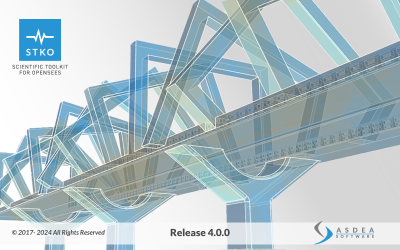
STKO 4.0.0: Transforming Structural Analysis with Powerful New Features
STKO 4.0.0: Boost Accuracy and Efficiency in Structural Analysis with New Features.
STKO 4.0.0 revolutionizes structural analysis with advanced features, improved workflows, cohesive zones, and automated mass assignment tools. This update introduces innovative features such as shell-section extrusion, frame-step animation, and custom transformation operators. Additionally, it expands material model capabilities with new options like ASDConcrete3D, zeroLengthContactASDimplex, ASDShellT3, ASDCoupledHinge3D, and the uniaxial material ASDConcrete1D.