Imagine a world where our concrete structures, from bridges and buildings to critical infrastructure, last longer, require less maintenance, and can endure the harshest environments. This vision is not a distant dream but a reality emerging thanks to innovative materials like Glass Fiber Reinforced Polymers (GFRP). As we seek more durable and sustainable solutions, researchers and engineers are now exploring the potential of GFRP to replace traditional steel reinforcement. A few examples of bridges built with reinforcement demonstrate the growing adoption of this innovative material in infrastructure projects. [1], [2], [3], [4], [5]. The most recent application is the Harkers Island Bridge Replacement Project [6], where cutting-edge technologies like carbon FRP (CFRP) strands and GFRP rebars enhance the bridge’s durability and sustainability. The new Harkers Island Bridge is engineered to withstand the coastal environment better, reducing maintenance needs and extending lifespan.

Figure 1. Harkers Island Bridge Replacement Project, courtesy of Paolo Casadei, Owens Corning and Peter DiStefano, Balfour Beatty
Nevertheless, like all groundbreaking advancements, this approach comes with its challenges. This article presents a new hybrid reinforcement strategy. This game-changing solution combines the best of both worlds: the strength and ductility of steel with the corrosion resistance and lightness of GFRP.
Why GFRP? The sustainable solution for Concrete Reinforcement
GFRP will rapidly transform the construction industry. Unlike steel, GFRP does not rust, making it an ideal choice for structures in harsh environments, such as coastal areas where saltwater can quickly corrode traditional materials. Beyond its corrosion resistance, GFRP offers the advantage of being significantly lighter than steel, simplifying handling and installation. This accelerates construction timelines, reduces labor costs, and contributes to sustainability by lowering transportation costs and environmental impact. The lighter weight of GFRP reduces the energy required for transport, further enhancing its appeal as a modern, eco-friendly solution for construction projects.
However, GFRP is not without its drawbacks. Its brittleness and limited ductility can be concerning, especially in seismic zones where buildings must dissipate energy during the seismic event. This limitation has led engineers to hesitate to adopt GFRP fully. However, combining the durability and resilience of steel in critical areas with the exceptional corrosion resistance of GFRP where it is most effective, presents an optimal solution. This is where the hybrid reinforcement strategy comes into play.
The Hybrid Solution: combining ductility, strength and durability
The hybrid reinforcement strategy is an innovative solution that combines the strength of GFRP with the ductility of steel. This solution strategically places steel bars in the structure’s most critical or plastic hinge regions, as shown in Figure 2, ensuring it maintains its ductility and load-bearing capacity.

Figure 2. Schematic of the foundation-column hybrid joint connection
These critical regions are areas within the structure where higher demand for strength, ductility, and performance occurs due to concentrated stresses or significant deformation under specific loading conditions. Properly reinforcing these regions for their critical length Lcr (as shown in Figure 2) is crucial for ensuring the overall safety and integrity of the structure, especially during extreme events such as earthquakes. Traditional steel rebars are used in these areas and are detailed with international standards such as Eurocode 8 or ASCE07 to ensure the required ductility. Steel bars are placed with a larger concrete cover depth and are fully anchored, providing enhanced corrosion protection and the necessary ductility to withstand dynamic loads. Meanwhile, GFRP bars are not anchored to the foundation and are used outside the critical regions Lcr, where high ductility is not required.
By placing GFRP externally, beyond the critical zones, the structure benefits from GFRP’s advantages without compromising the overall ductility. This hybrid approach ensures that the structure not only meets but exceeds the performance of traditional steel-reinforced designs, offering a perfect balance between durability, weight, and strength.
Finite Element Analysis of Hybrid Reinforced Structures
Extensive 3D solid nonlinear Finite Element (FE) analyses were performed on various structural components and entire systems using STKO and OpenSees. The focus of the study included foundation-column joints, external and internal column-beam joints, and a reinforced concrete (RC) frame. These analyses were validated against experimental data from existing literature to ensure their accuracy and applicability. The simulations employed advanced material models, including the ASDConcrete3D constitutive model, to capture concrete’s plasticity and damage characteristics, as illustrated in Figure 3.
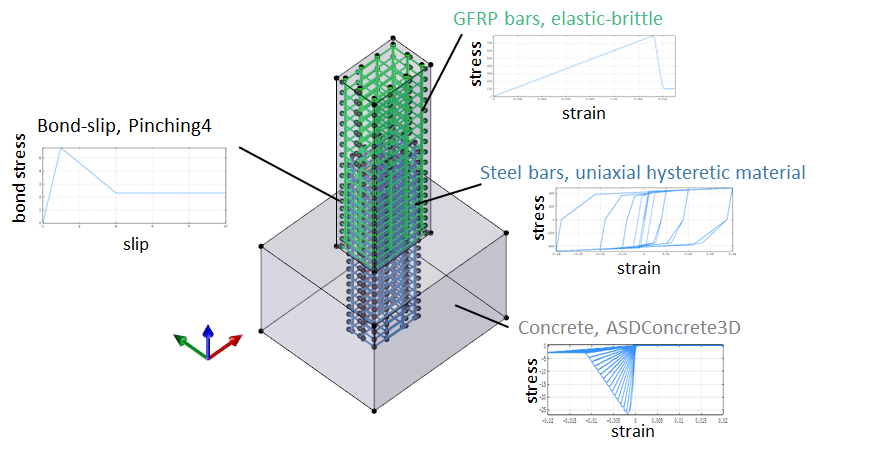
Figure 3. Finite Element model

Figure 4. Traditional and Hybrid solution cyclic shear.
The hysteretic behavior of steel was also incorporated, along with the elastic-brittle properties of GFRP rebars. Additionally, the models accounted for critical factors such as rebar buckling and bond-slip effects, which are crucial for accurately simulating the complex interactions within the structures under load. Figure 3 presents the finite element (FE) model of the test conducted by Park and Paulay [7], modified to incorporate the GFRP cage.
The results indicate that the ductility and load-bearing capacity of the proposed hybrid structures, which integrate traditional steel with GFRP reinforcement, are comparable to those of conventional steel-reinforced structures.
Figure 5 illustrates the maximum crack width and the stresses in the GFRP in two different time steps. The GFRP is not anchored to the foundation, and its stress levels remain well below the characteristic strength of the GFRP. This is a significant finding, especially for regions prone to seismic activity, where maintaining structural integrity during dynamic events is crucial. The research also highlighted how this hybrid approach could significantly extend the lifespan of structures, reducing maintenance needs and enhancing overall performance.

Figure 5. Maximum crack width and GFRP stress
The Future of Construction
The hybrid GFRP-steel reinforcement strategy is more than just an engineering innovation; it is a leap forward for the construction industry. In a world where infrastructure is the backbone of development, innovations like the GFRP-steel hybrid approach are beneficial and essential; combining the best properties of both materials offers a sustainable, durable, and efficient solution for modern construction challenges. Whether it is building bridges that can withstand the test of time or skyscrapers that remain resilient in the face of natural disasters, the hybrid reinforcement strategy is paving the way for a new, more durable, and sustainable solution in construction.
Author(s): Guido Camata1, Kaushal Patel1, Enrico Spacone1, Massimo Petracca2, Antonio Nanni3
- guido.camata@unich.it, University “G. D’Annunzio” at Chieti-Pescara
- m.petracca@asdea.net, ASDEA software srl
- nanni@miami.edu, University of Miami
Sources:
- https://www.iifc.org/wp-content/uploads/2024/03/IIFC-Newsletter-2024-Vol21-No1.pdf
- El-Salakawy, Ehab & Benmokrane, Brahim & Masmoudi, Rafik & Brière, F. & Breaumier, É. (2003). Concrete Bridge Barriers Reinforced with Glass Fiber-Reinforced Polymer Composite Bars. Aci Structural Journal. 100. 815-824.
- https://www.pci.org/PCI_Docs/Publications/PCI%20Journal/2002/Sept-Oct/Design-Construction%20of%20Bridge%20Street%20Bridge%20-%20First%20CFRP%20Bridge%20in%20the%20United%20States.pdf
- https://www.tac-atc.ca/wp-content/uploads/benmok.pdf
- https://www.fdot.gov/docs/default-source/structures/Innovation/CAMX-2017-Halls-River-Bridge-corrosion-free-Design-with-FRP-composites.pdf
- https://www.ncdot.gov/projects/harkers-island/Pages/default.aspx
- Park, R.; and Paulay, T. 1990. Use of Interlocking Spirals for Transverse Reinforcement in Bridge Columns, Strength and Ductility of Concrete Substructures of Bridges, RRU (Road Research Unit) Bulletin 84, Vol. 1, pp 77-92 (https://nisee.berkeley.edu/spd/servlet/display?format=html&id=26)
Related Articles

Civic Tower of Ravenna – Blending Ancient Techniques with Modern Technology
Discover how ASDEA’s MonStr Hardware protects the Civic Tower of Ravenna through smart structural health monitoring. Learn how modern technology and ancient craftsmanship combine for proactive heritage preservation.

The Importance of Seismic Design in Structural Engineering- Ensuring Safety in High-Risk Regions
Seismic design is essential for earthquake resilience. This blog explores key structural engineering principles, advanced techniques like capacity design, and the role of advanced simulation tools such as Asdea STKO for OpenSees and MonStr System in predicting and controlling damage evolution to ensure safer, more durable structures in high-risk regions.
STKO 4.0.0: Transforming Structural Analysis with Powerful New Features
STKO 4.0.0: Boost Accuracy and Efficiency in Structural Analysis with New Features.
STKO 4.0.0 revolutionizes structural analysis with advanced features, improved workflows, cohesive zones, and automated mass assignment tools. This update introduces innovative features such as shell-section extrusion, frame-step animation, and custom transformation operators. Additionally, it expands material model capabilities with new options like ASDConcrete3D, zeroLengthContactASDimplex, ASDShellT3, ASDCoupledHinge3D, and the uniaxial material ASDConcrete1D.